
What kind of data do Tobii Eye Trackers provide?
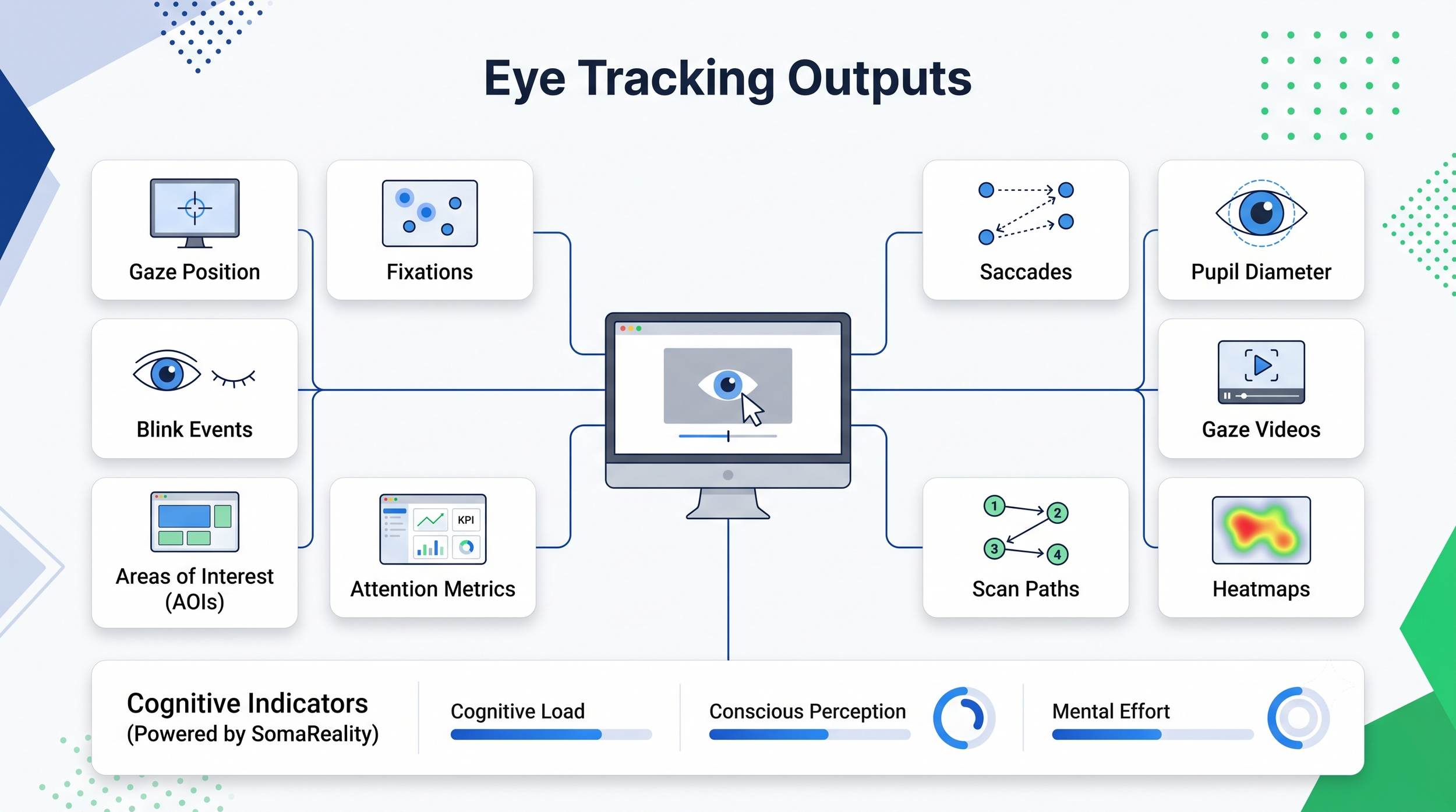
Depending on the product, outputs may include:
Gaze position: Where the participant being tracked is looking. This data is usually discrete but at a rapid acquisition rate the time between two samples is minute.
Fixations: A fixation can be defined as wherever the participant fixates on for a variable duration above a certain specified floor value. A fixation is associated with a stimulus being perceived.
Saccades: The journey between two fixations is known as saccades, these can be classified as involuntary or voluntary rapid jerks shifting the focal vision from a certain location to the next. Visual processing is impaired by brain when saccades happen to prevent blurring.
Pupil Diameter: The pupil expands in response to increased mental effort, memory retrieval, or stress. Trackers calculate this by measuring the pupil's physical diameter in milli-meters. It is a powerful physiological metric used to measure cognitive load, mental effort, and emotional arousal.
Blink Events: A blink is the temporary, rapid closure of the eyelids, Blinks are measured by tracking either pupil disappearance or direct eyelid position (eye openness). Blink rate refers to the frequency and duration of blinks, used popularly for drowsiness studies.
Gaze Videos: It refers to recording, analyzing, or overlaying eye movements directly onto a visual scene, allowing you to see exactly where and how someone views a video or screen in real time. Necessary for qualitative analysis.
Areas of Interest (AOIs): AOIs are user defined regions where quantitative metrics like time to first fixation, dwell time, etc. are obtained to have a quantitative outlook of the user behaviour.
Attention metrics: Visual attentional allocation can be deduced from a combination of the metrics obtained from defined AOIs like fixation duration, dwell time, and Time to First Fixation (TTFF).
Scan paths: Sequential visualizations of eye movements showing the order and flow of fixations and saccades as participants explore a scene.
Heatmaps: Color-coded visual representations of aggregated gaze data that highlight the areas receiving the most visual attention across one or more participants.
Cognitive indicators (using Soma Reality): Empirical model based metrics derived from eye movement patterns and pupil data that estimate cognitive states such as cognitive load, conscious perception.
If you want to learn more about eye tracking technologies connect us on www.tidentech.com or feel free to ask us on parag@tidentech.com or tidentech@gmail.com call us on +91 9987442274