
How Accurate Is Tobii Pro Glasses 3, and What Technologies Help Maintain Tracking Quality During Natural Movement?
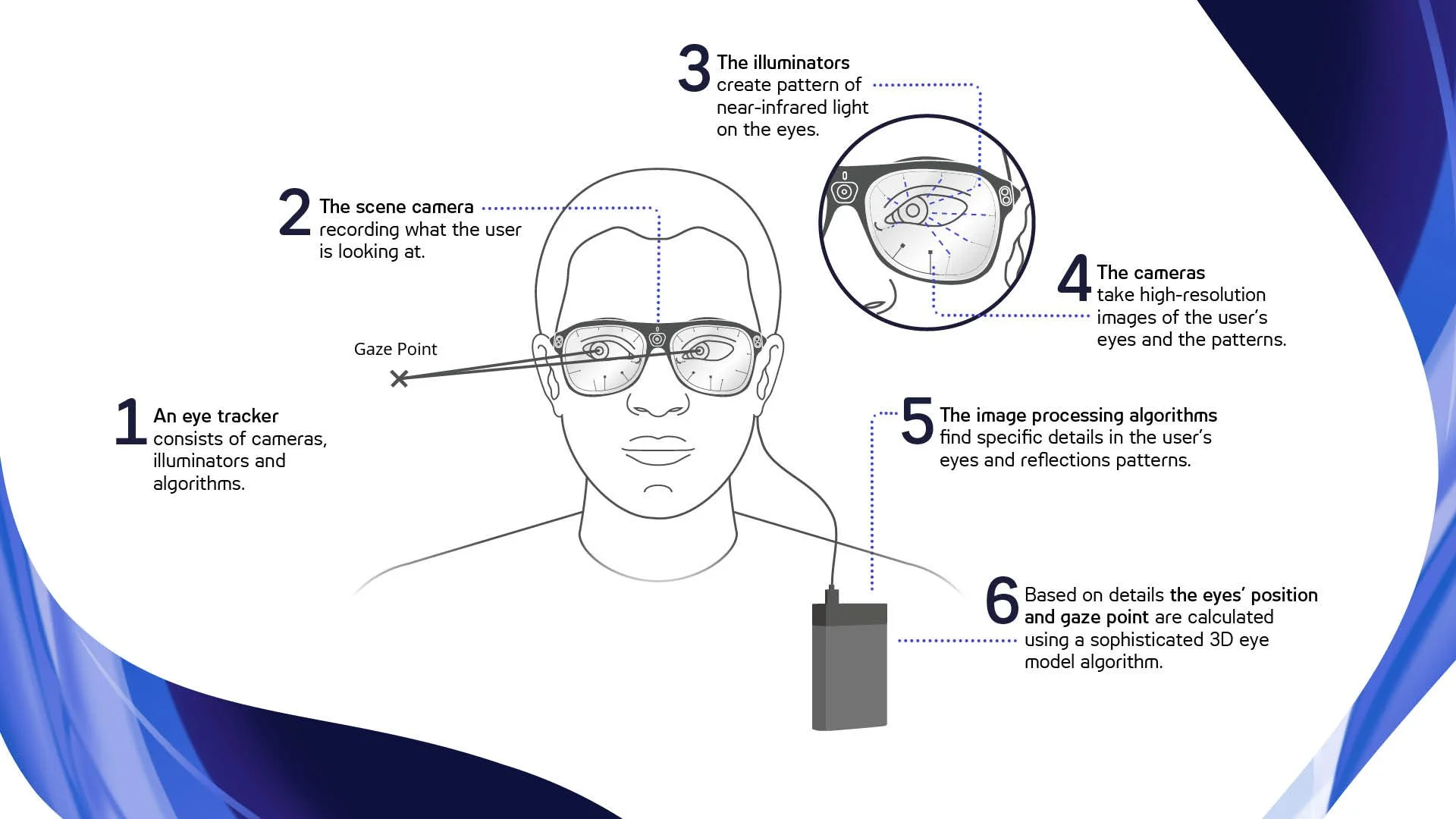
In scenarios where participants are allowed to walk freely, Tobii Pro Glasses 3 are designed to deliver dependable, scientific-grade eye tracking accuracy. The system is appropriate for studies involving visual attention, fixation analysis, decision-making, human factors, and cognitive behavior since it provides a typical gaze accuracy of 0.6° and supports binocular eye tracking at 50 Hz or 100 Hz. The glasses are specifically made for real-world research where participants may walk, bend, turn, or interact with complicated situations, as opposed to being tailored primarily for static laboratory investigations.
Eye Tracking Accuracy:
Tobii Pro Glasses 3 delivers:
Typical gaze accuracy: 0.6°
Binocular eye tracking
Sampling rates: 50 Hz and 100 Hz
These specifications make the system suitable for research involving:
Visual attention
Fixation analysis
Decision-making
Human factors
Cognitive behaviour
Patented 3D Eye Model:
The patented 3D eye model is one of the features that sets Tobii Pro Glasses 3 apart.
The technology continually evaluates each eye's three-dimensional position and orientation rather than depending just on two-dimensional pupil tracking. This makes it possible for gaze estimate to stay constant over extended recording sessions, even when the person shifts their head position or the glasses move slightly.
Automatic Parallax Compensation:
Another important capability is automatic parallax compensation.
Because the scene camera is positioned above the participant's eyes, the apparent gaze location changes depending on the distance to the object being viewed. Tobii automatically compensates for this geometric difference, allowing gaze points to remain accurate when participants shift their attention between nearby objects and distant targets.
This is especially valuable in:
Retail research
Surgical training
Industrial inspections
Automotive studies
and other scenarios involving frequent changes in viewing distance.
Automatic Slippage Compensation:
In the event that the headset moves slightly on the participant's face, the system's automatic slippage compensation helps preserve calibration accuracy.
Even slight motions can lower measurement accuracy and necessitate recalibration in many wearable eye tracking devices. By automatically correcting for slight headset displacement, Tobii Pro Glasses 3 reduces this issue and enhances data quality and workflow effectiveness during field research.
Technologies That Maintain Tracking Quality:
Combined with:
Four dedicated eye tracking sensors
Binocular tracking
Integrated motion sensors
Tobii's mature eye tracking algorithms
these technologies enable researchers to collect reliable gaze data in:
Classrooms
Hospitals
Factories
Sports facilities
Airports
Retail environments
and numerous other real-world settings where traditional eye tracking systems would be difficult to deploy.
Summary:
Together, the system's 0.6° gaze accuracy, patented 3D eye model, automatic slippage compensation, automatic parallax compensation, binocular eye tracking, integrated motion sensors, and mature eye tracking algorithms help maintain reliable eye tracking quality during natural movement in real-world research environments.